
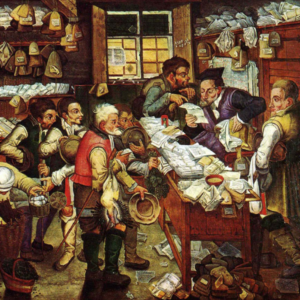
One might wonder why taxation is not one of the hottest topics among historians, as it is one of the most central pieces of government politics. Without taxation there would be no redistribution, no government spending, no education, no infrastructure nor healthcare – thus: no striving for equality. The history of taxation perfectly explains the changing political regimes on equality in Europe. During the Industrial Revolution, particularly in the late nineteenth and early twentieth century, inequality rose rapidly. This period was followed by a new political regime in which equality levels increased as a result of taxation. From the 1980s onwards, inequality began to grow again. Outside Europe, taxation was also used to uphold colonial power relations. One of the main questions for colonial regimes was whether they should align with indigenous taxation practices or introduce their own. The answer to this question could have enormous consequences. In this workshop, we will discuss how historians could benefit from the studies of taxation and how we should understand the changing political regimes on equality. Finally, we will learn how important taxation was for maintaining colonial power ‘relations’.
Marc Buggeln (Flensburg), Tax regimes and equality: why study the history of taxation
Marjolein ’t Hart (VU/Huygens (invited), Why Taxes Are Good for Democracy: State Formation and Political Culture in a World-Historical Perspective
Maarten Manse (Linnaeus University), Compromise and adaptation in colonial taxation: fiscal ideology, policy, practice and inequality in colonial Indonesia, ca. 1870-1920
This workshop is explicitly open to research master students and PhD candidates. After the workshop, there will be an opportunity to exchange thoughts and ideas during free drinks.
Practical information
Credits: 1 EC
Location: Amsterdam city centre (exact venue TBA)
Free admission, but please register by sending an email to: [email protected] before 6 February 2026
Please include in your registration a one-page statement reflecting on how the history of taxation could provide new perspectives on your research.
For more information, please contact [email protected]